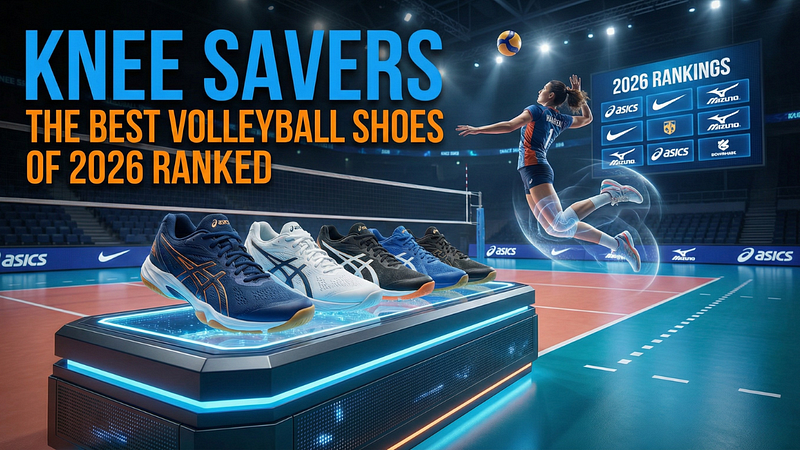
Knee Savers: The Best Volleyball Shoes of 2026 Ranked
Discover the best volleyball shoes of 2026 ranked. The “Knee Saver” guide tests the top 5 models, including Nike and ASICS, for max output.
If you play volleyball long enough, you learn one hard truth: your knees have a shelf life. The constant jumping, landing, and lateral cutting on hard courts puts an immense amount of torque and impact stress on your joints. We spend hours scrolling social media, looking up Alexis Clark net worth or the latest transfer rumors, but we often spend less than five minutes picking the equipment that actually saves our careers.
In 2026, footwear technology has finally caught up to the vertical demands of the modern game. Gone are the days of choosing between a heavy, clunky shoe that absorbs shock or a light shoe that leaves your joints exposed. The 2026 lineup features aerospace-grade foams and impact dispersion systems.
We tested the top models on the market to find the true “Knee Savers” — the shoes that allow you to play a five-set match on Saturday and still walk down the stairs on Sunday.
1. The Heavy Hitter: ASICS Sky Elite FF 3
Best For: Hitters, Blockers, and Players with History of Knee Pain
Knee-Saver Rating: 10/10
The ASICS Sky Elite series has long been the gold standard for attackers, but the FF 3 model takes joint protection to an entirely new level.
Why It Saves Your Knees: The magic lies in the midsole. ASICS has integrated their proprietary FF BLAST™ PLUS Eco cushioning. When you land from a max-effort spike, the foam compresses to absorb the G-force that would usually travel up your shin and into your patellar tendon.
Additionally, the RISETRUSS™ technology isn’t just a fancy marketing term. It’s a plastic shank in the sole that resists twisting. This ensures that when you land awkwardly, the shoe stabilizes your foot, preventing the rotational torque that tears meniscus cartilage.
- Pros: Maximum impact absorption; Curved heel shape for smooth transition.
- Cons: Slightly heavier than “speed” shoes.
- Verdict: If you are an Outside Hitter or Middle Blocker who jumps 50+ times a match, this is your insurance policy.
2. The Crossover King: Nike Lebron XXI (21)
Best For: Power Players seeking Basketball-Level Cushioning
Knee-Saver Rating: 9.5/10
“Wait, isn’t that a basketball shoe?” Yes. And in 2026, more pro volleyball players are wearing basketball shoes than ever before because the cushioning is often superior.
Why It Saves Your Knees: The Lebron 21 is essentially a mattress with laces. It features a Zoom Turbo unit in the forefoot and a massive Zoom Air unit in the heel. Unlike foam, which can bottom out over time, Air units provide consistent return.
For volleyball players, this is critical during the “braking” phase of an approach. That final step — where you plant your heel to transfer forward momentum into upward momentum — is where most knee damage occurs.
- Pros: Unmatched cushioning tech; Incredible ankle lockdown.
- Cons: Heavier and bulkier; Ventilation can be poor.
- Verdict: If you are a heavier player or simply want the softest landing possible, cross over to the basketball aisle.
3. The Speedster’s Shield: Mizuno Wave Lightning Z8
Best For: Setters, Liberos, and Outside Hitters who value speed
Knee-Saver Rating: 8.5/10
Mizuno has always been known for “court feel” — being low to the ground so you can react quickly. The Z8 changes the narrative by introducing Mizuno Enerzy NXT.
Why It Saves Your Knees: Mizuno uses a physical Wave Plate — a plastic wave-shaped sheet embedded in the foam. This plate disperses impact energy laterally (sideways) rather than letting it shoot straight up your leg. It’s the perfect compromise for a setter who needs to be quick but also jumps 100 times a game to block or set.
- Pros: Extremely lightweight; Best-in-class traction.
- Cons: Cushioning is thinner than the ASICS Sky Elite.
- Verdict: The best balance of speed and protection.
4. The Cloud Walker: Adidas Crazyflight 5
Best For: Female athletes and light-footed jumpers
Knee-Saver Rating: 8/10
The Adidas Crazyflight has a cult following for a reason. It looks great, feels like a sock, and uses the legendary Boost technology.
Why It Saves Your Knees: If you’ve ever worn Adidas UltraBoost running shoes, you know the feeling. The midsole is made of thousands of expanded thermoplastic pellets fused together. For the Crazyflight 5, Adidas encased the Boost foam in an EVA stability frame. This prevents the “squishy” feeling that can lead to rolled ankles, while still keeping the soft landing pad directly under your heel.
- Pros: Very breathable upper; Stylish design; Boost foam is incredibly durable.
- Cons: Traction on dusty courts can be hit-or-miss.
- Verdict: A fantastic, stylish option that offers a “soft” ride rather than a “bouncy” one.
5. The Budget Defender: ASICS Gel-Rocket 12
Best For: Recreational players, Club beginners
Knee-Saver Rating: 7.5/10
You don’t always need to spend $180 to protect your knees. The Gel-Rocket series is the Honda Civic of volleyball shoes: reliable, affordable, and surprisingly effective.
Why It Saves Your Knees: It’s all in the name: GEL. ASICS places a silicone-based Gel unit in the forefoot. While it lacks the full-length fancy foams of the Sky Elite, that forefoot Gel is situated exactly where you land when you come down from a block or a hit. It provides ample protection for the player who hits the court once or twice a week.
- Pros: Affordable ($70-$90 range); Durable rubber outsole.
- Cons: Heavier than premium models; Upper materials feel stiffer.
- Verdict: The undisputed king of entry-level protection.
The “Knee-Saver” Buying Guide: What to Look For
When you are shopping for your next pair of shoes in 2026, you need to filter out the noise. It is easy to get distracted by the visual side of the sport — whether it’s flashy colorways, viral social media clips, or the internet’s immature obsession with searches like volleyball butts — but when you’re landing from 30 inches in the air, aesthetics won’t save your meniscus.

If your priority is knee health, ignore the trends and look for these three technical features:
1. Stack Height vs. Stability
There is a myth that “thicker is better.” While a thick sole (high stack height) provides more foam to compress, it can also make you unstable — like standing on a wobbly yoga block.
- The Sweet Spot: Look for shoes with a high stack height in the heel but a stable, wide base in the forefoot. The ASICS Sky Elite and Nike React Hyperset 2 excel at this.
2. Torsional Rigidity (The Twist Test)
Your knee connects your thigh to your shin. If your foot twists one way and your thigh twists the other, your knee takes the damage.
- The Test: Pick up the shoe. Grab the toe and the heel. Try to twist them in opposite directions.
- The Goal: A “Knee Saver” shoe should be difficult to twist. It should have a plastic shank (like the Mizuno Wave Plate or ASICS Trusstic) in the middle to force the shoe to land flat.
3. Forefoot Cushioning
Many shoes pack cushioning in the heel, assuming you run like a jogger. But volleyball players often land on their toes or mid-foot.
- What to check: Press your thumb hard into the ball of the foot area inside the shoe. You need a layer of responsive foam (Zoom Air, Enerzy, or Gel) in the front of the shoe to protect your patellar tendon during takeoff and blocking landings.
Conclusion: An Investment in Longevity
In 2026, buying volleyball shoes is cheaper than paying for physical therapy.
If you are currently suffering from knee pain, I highly recommend looking at the ASICS Sky Elite FF 3 or the Nike Lebron 21. The transition to a max-cushion shoe can often provide immediate relief, allowing inflammation to subside while you continue to play.
Remember, the best ability is availability. Treat your feet to the best technology 2026 has to offer, and keep flying.