15 Films That Defined My January: From The Father to Palm Springs
A month of sitting in the dark, being emotionally devastated by strangers on screens.” A personal experience of watching 15 impactful…
15 Films, One Month, Countless Feelings
A Personal Watch Experience from January 2026
January is supposed to be a month of fresh starts, resolutions, and productivity. Mine turned into a month of sitting in the dark, being emotionally devastated by strangers on screens, and questioning the fundamental nature of human connection.
I watched fifteen films. Not a single one was chosen with a plan. Some were late-night impulses, others were recommendations that had been gathering dust in my watchlist for years, and a couple were re-watches that hit differently this time around. Looking back now, what strikes me is not just how diverse this list turned out — spanning Turkish arthouse to Andy Samberg comedies, Japanese psychological horror to a children’s fantasy about grief — but how they spoke to each other in ways I never anticipated.
What follows is not a review column. This is a personal account of what it felt like to live with these films for a month, how they lingered in my thoughts between viewings, and why I believe every single one of them is worth your time.
1. The Father (2020)
Director: Florian Zeller | Cast: Anthony Hopkins, Olivia Colman | IMDb: 8.3 | RT: 98%
2 Oscars including Best Actor (Hopkins) and Best Adapted Screenplay
I started the month with a film that made me forget how to breathe. The Father is not merely a film about dementia — it is dementia, experienced from the inside.
Florian Zeller, adapting his own stage play, does something I have never seen done this effectively on screen: he collapses the audience’s perception of reality alongside its protagonist’s. The apartment shifts. Faces change. Timelines fold over themselves. You are not watching Anthony losing his mind — you are losing yours with him.
Hopkins, who won his second Oscar at age 83 for this role, delivers what many rightly call the performance of his career. He moves from imperious charm to childlike terror in a single breath. And Olivia Colman, as the daughter navigating the impossible grief of losing a parent who is still alive, matches him in every frame.
The final scene left me in ruins. It is, without exaggeration, one of the most devastating endings I have ever experienced in cinema. If you have anyone in your life who has dealt with cognitive decline, this film will break something inside you. If you have not, it will prepare you with a compassion you did not know you needed.
2. The Vast of Night (2019)
Director: Andrew Patterson | Cast: Sierra McCormick, Jake Horowitz | IMDb: 6.7 | RT: 92%
Winner of the Slamdance Audience Award; shot on a micro-budget
This film has no right being this good. It was made for practically nothing by a first-time director from Oklahoma, and it contains a single tracking shot that would make Spielberg weep with envy — racing through an entire small town, cutting through a basketball game, and sweeping across the night.
The Vast of Night is set in 1950s New Mexico and follows a teenage switchboard operator, Fay, and a radio disc jockey, Everett, who discover a strange audio frequency. That is the entire setup.
What makes it extraordinary is how it tells this story. There is a ten-minute single take of Fay at the switchboard — plugging wires, fielding calls, her alarm rising — that is more gripping than most action sequences I have seen.
The dialogue crackles with intelligence and period-perfect authenticity. Andrew Patterson understands something fundamental: the best science fiction is not about the spectacle of what is out there. It is about the yearning of those who look up. I watched this alone, late at night, with headphones on. I cannot recommend that experience highly enough.
3. Sound of Metal (2019)
Director: Darius Marder | Cast: Riz Ahmed, Olivia Cooke, Paul Raci | IMDb: 7.7 | RT: 97%
Winner of 2 Oscars for Best Sound and Best Film Editing; 6 nominations total including Best Picture
If The Father put me inside the experience of dementia, Sound of Metal put me inside the experience of sudden deafness. The sound design alone justifies this film’s existence — the way it alternates between the muffled, distorted world Ruben hears and the rich, full soundscape we take for granted is nothing short of revolutionary filmmaking.
But this is not a film about hearing loss in the mechanical sense. It is about what happens when the thing that defines you — your identity, your purpose, your daily rhythm — is ripped away overnight.
Riz Ahmed prepared for this role by spending months learning ASL and drumming, and that dedication bleeds through every frame. He does not perform deafness — he inhabits the panic, denial, and eventual reckoning of it. Paul Raci, as the deaf recovering alcoholic who runs the shelter, delivers one of the most quietly powerful supporting performances I have ever seen.
The final scene, where Ruben sits on a bench in Paris and removes his cochlear implants to embrace the silence, is a masterpiece of restraint. It is not a happy ending or a sad one. It is something rarer: an honest one.
4. Once Upon a Time in Anatolia (2011)
Director: Nuri Bilge Ceylan | IMDb: 7.8 | RT: 94%
Co-winner of the Grand Prix at the 2011 Cannes Film Festival
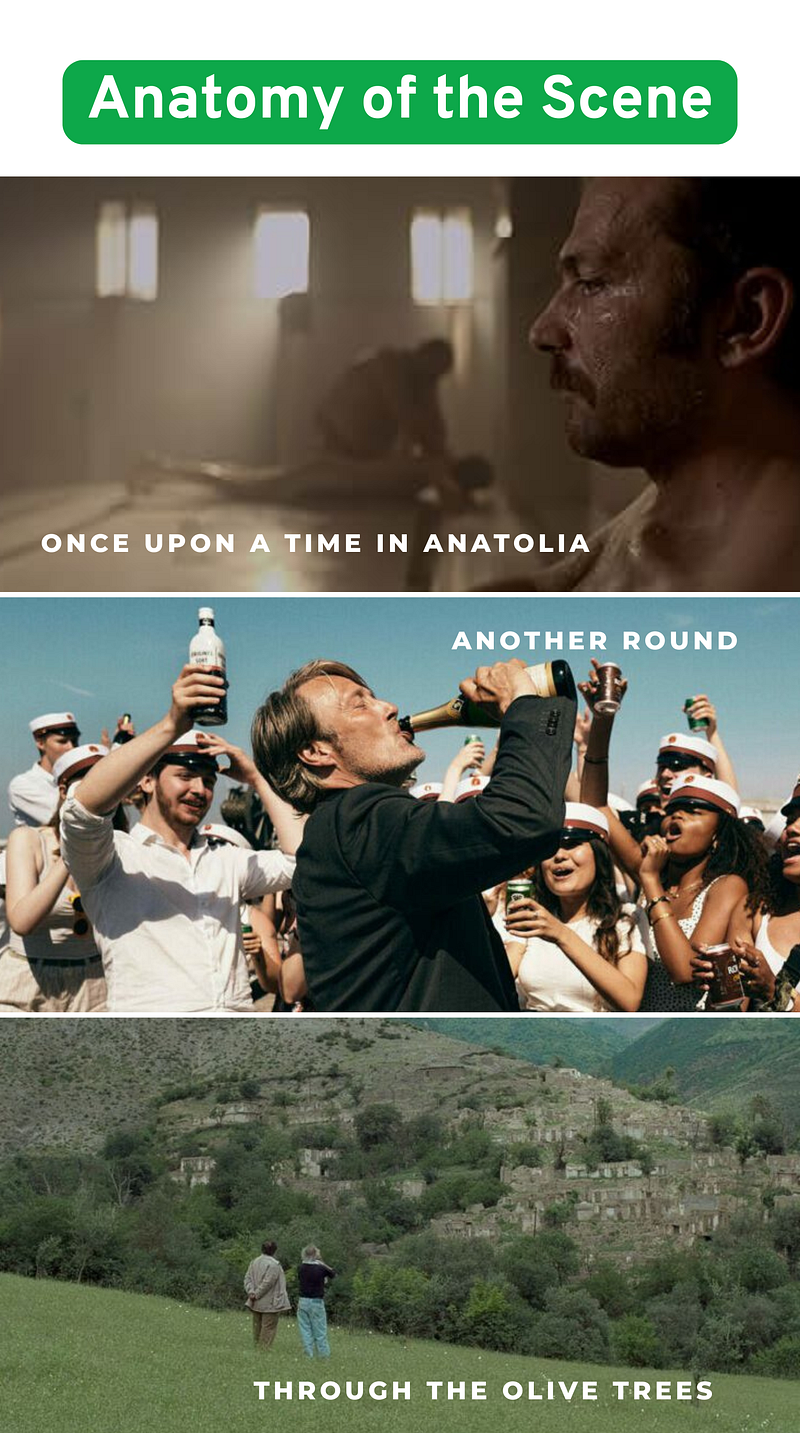
This is the film on my list that demands the most patience and rewards it tenfold. At 157 minutes, it follows a group of men — police, a doctor, a prosecutor, and a murder suspect — as they drive through the vast Anatolian steppe at night searching for a buried body.
For the first hour, almost nothing happens in the conventional sense. Cars stop. Men get out, look around, get back in. The suspect cannot remember where he buried the body because he was drunk.
And yet every single minute is riveting because Ceylan is not making a procedural — he is making a film about what people reveal about themselves when they are tired, uncomfortable, and stripped of pretense. The conversations are philosophical, mundane, funny, and devastating by turns.
There is a scene where a village mayor’s daughter brings tea to the weary search party, and the way Ceylan frames her face in the lamplight is one of the most breathtaking images I have ever seen in cinema. Based on a real experience of one of the co-writers, this film is about how death makes philosophers of us all, whether we want it to or not. Watching it felt like reading a great Russian novel.
5. Aattam (2023)
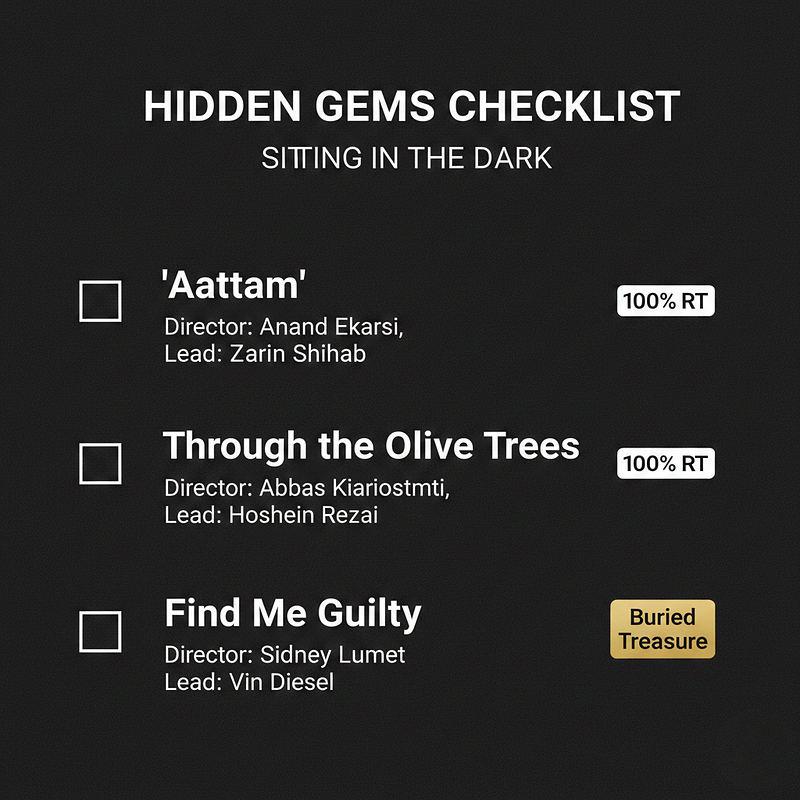
Director: Anand Ekarshi | Cast: Zarin Shihab, Vinay Fort | IMDb: 8.1 | RT: 100%
Winner of the National Film Award for Best Feature Film and Grand Jury Award at IFFLA
Malayalam cinema has been on an extraordinary run in recent years, and Aattam is among its finest achievements. The title translates to “The Play,” and the film is a devastating deconstruction of male hypocrisy disguised as a locked-room mystery.
The premise is deceptively simple: Anjali, the sole female member of a theatre troupe, is sexually assaulted during a celebration. What follows is a meeting of the remaining eleven men to decide what to do.
Comparisons to 12 Angry Men are inevitable but ultimately misleading. In Sidney Lumet’s classic, the truth eventually wins. In Aattam, truth becomes a casualty of male self-interest, cowardice, and the thousand small compromises that men make to preserve their comfort. Every single male character — even the ones who initially seem like allies — reveals some ugliness under pressure.
The writing is razor-sharp, the ensemble performances are extraordinary, and the film’s refusal to offer a tidy resolution is its greatest strength. Zarin Shihab’s final scene will stay with you for days. This is the kind of film that forces you to examine your own complicity, and it does not let you off the hook.
6. Another Round (2020)
Director: Thomas Vinterberg | Cast: Mads Mikkelsen | IMDb: 7.7 | RT: 92%
Winner of the Oscar for Best International Feature Film; dedicated to the director’s daughter Ida, who died during production
I expected a comedy about drinking. What I got was a profoundly moving meditation on midlife stagnation, the terror of wasted potential, and the desperate human need to feel alive. Four Danish high school teachers decide to test a theory that humans function better with a constant 0.05% blood alcohol level.
The initial results are glorious — the teachers become more engaged, more present, more themselves. And then, inevitably, the experiment escalates.
Mads Mikkelsen is incandescent in this film. His history teacher Martin goes from a shell of a man barely surviving his own classroom to someone radiating joy and vulnerability, and then to places much darker. Knowing that Vinterberg’s 19-year-old daughter Ida — who had encouraged him to make the film — was killed in a car accident just four days into shooting gives the entire enterprise an undercurrent of grief that transforms what could have been a clever concept film into something genuinely life-affirming.
The final scene — Mikkelsen dancing on the waterfront, with the camera holding on his face as he leaps — is one of the greatest endings in modern cinema. Does he live? Does he fall? It does not matter. For that one suspended moment, he is magnificently, terrifyingly free.
7. Palm Springs (2020)
Director: Max Barbakow | Cast: Andy Samberg, Cristin Milioti, J.K. Simmons | IMDb: 7.4 | RT: 94%
Broke the Sundance acquisition record at $22 million; Metacritic score of 83
After the emotional demolition of The Father, Sound of Metal, and Another Round, I needed something lighter. Palm Springs appeared on my screen at exactly the right moment, and it turned out to be far more than a palette cleanser.
Yes, it is a time loop comedy in the tradition of Groundhog Day. But it is also a sneakily profound film about depression, about the numbness that comes from feeling like nothing you do matters, and about the wild possibility that love can still make repetition bearable.
Samberg and Milioti have electric chemistry — warm, funny, and genuinely tender. The script is sharp enough to earn its existential moments without ever becoming pretentious, and J.K. Simmons contributes a scene near the end that is so quietly devastating it reframes the entire film.
The message at its core — that it is not what we do that keeps us happy but who we do it with — could have been saccharine. Instead, it lands like a truth you have always known but needed to be reminded of.
8. The Body / El Cuerpo (2012)
Director: Oriol Paulo | Cast: José Coronado, Hugo Silva, Belén Rueda | IMDb: 7.6 | RT Audience: 79%
Nominated for Goya Award for Best New Director; remade in South Korea, India, and optioned for an English remake
Spanish thriller cinema has quietly become one of the most reliable genres in the world, and The Body is a masterclass in why. A woman’s corpse disappears from the morgue. Her young husband is the obvious suspect. A weary detective starts pulling at threads. That is all you need to know before pressing play, because to say more is to rob you of the whiplash ending that justifies the entire exercise.
Oriol Paulo, who would later direct the equally twisty The Invisible Guest, proves here that Hitchcock’s spirit is alive and well in Barcelona. The film unfolds primarily in the morgue across a single night, building claustrophobic tension through sharp dialogue and a script that always seems to be two steps ahead of you.
Just when you think you have figured it out, the floor drops. And then drops again. It is not deep cinema, and it does not pretend to be. But as a piece of pure, propulsive genre entertainment, it is nearly flawless.
9. 303 (2018)
Director: Hans Weingartner | Cast: Mala Emde, Anton Spieker | IMDb: 7.5 | RT: 83%
Premiered at the 2018 Berlin International Film Festival; director was a production assistant on Before Sunrise
Here is a film that should not work. Two German university students share a Mercedes 303 camper van on a road trip from Berlin to Portugal. They talk. For two hours and twenty-five minutes. About capitalism, evolutionary biology, relationships, death, faith, and the nature of love. That is the entire film.
And it is magical. Director Hans Weingartner — who worked as a production assistant on Before Sunrise — has made the most organic, warm, and intellectually stimulating romance I have encountered in years. Mala Emde and Anton Spieker have the kind of natural chemistry that cannot be manufactured, and their conversations feel so authentic you forget a camera is present.
The European countryside scrolls past the windows like a living painting, and the slow gravitational pull between Jule and Jan — the way philosophical arguments become flirtation, the way disagreement becomes intimacy — is rendered with extraordinary delicacy. Think Before Sunrise with German earnestness and a camper van. By the time the final scene arrives, you will be clutching your armrest and you will not entirely understand why.
10. Bridge to Terabithia (2007)
Director: Gábor Csupó | Cast: Josh Hutcherson, AnnaSophia Robb, Zooey Deschanel | IMDb: 7.2 | RT: 85%
Based on Katherine Paterson’s 1977 Newbery Medal-winning novel; screenplay by the author’s son
I first watched this film as a teenager and found it devastating. Watching it again at a different stage of life, I found it devastating for entirely different reasons. On the surface, Bridge to Terabithia looks like a children’s fantasy film — two kids create an imaginary kingdom in the woods.
The marketing even pushed this angle with CGI creatures and fantasy imagery. But the fantasy is only the protective shell around a story about grief, loneliness, imagination as survival, and the unbearable fragility of the people we love most.
Josh Hutcherson and AnnaSophia Robb deliver performances of remarkable emotional intelligence for their age. When the film’s devastating turn arrives, it does so with the blunt force of real life — no warning, no dramatic music, no cinematic cushioning. Just the phone call, the disbelief, and then the long, awful reckoning with loss.
Re-watching it in January, after the heavier films on this list had already sensitized me, I wept in a way I had not wept at a film in a long time. Bridge to Terabithia understands something that most adult films struggle with: that imagination is not an escape from pain but the only bridge that can carry you across it.
11. Find Me Guilty (2006)
Director: Sidney Lumet | Cast: Vin Diesel, Peter Dinklage, Ron Silver | IMDb: 7.0 | RT: 62%
Based on the true story of the longest Mafia trial in American history; courtroom dialogue from actual transcripts
Yes, that Vin Diesel. And yes, directed by the man who gave us 12 Angry Men. This is the most delightful surprise on my entire list. Diesel plays Jackie DiNorscio, a low-level New Jersey mobster who, in the midst of the longest federal RICO trial in American history, fires his lawyer and defends himself.
The courtroom dialogue is lifted directly from real transcripts, and the result is a film that is simultaneously a sharp legal comedy, a meditation on loyalty, and a showcase for an actor most people have completely written off.
Diesel is genuinely, startlingly good here. In a ridiculous wig and with added weight, he transforms into a charismatic motormouth who wins over the jury through sheer personality. Peter Dinklage, as the lead defense attorney, delivers a performance of quiet brilliance.
As Roger Ebert noted, the film is not thrilling in the conventional sense, but it is genuinely interesting, and that is far rarer. Sidney Lumet, working at 81, still understood courtroom dynamics better than almost anyone, and his steady hand gives the film a lived-in authenticity that no amount of flash could replicate. A buried treasure of American cinema.
12. Unbroken (2014)
Director: Angelina Jolie | Cast: Jack O’Connell, Domhnall Gleeson, Miyavi | IMDb: 7.2 | RT: 51%
Based on Laura Hillenbrand’s bestselling biography of Louis Zamperini; screenplay co-written by the Coen Brothers
Critics were divided on Unbroken, and I understand why — Jolie’s direction sometimes leans toward conventional biopic territory. But what carries this film beyond its limitations is the sheer, staggering reality of Louis Zamperini’s story.
An Olympic distance runner who survived a plane crash over the Pacific, 47 days adrift on a life raft, and years of brutal captivity in Japanese prisoner-of-war camps. The story itself is almost too extraordinary for fiction.
Jack O’Connell brings a raw physicality and emotional depth to Zamperini that anchors the film through its most harrowing sequences. The 47 days at sea are genuinely gruelling to watch, and Miyavi as the sadistic camp commander Watanabe, known as “The Bird,” delivers a performance of controlled menace.
What compelled me about this film is its fundamental argument about human resilience — that the body can endure far more than the mind believes possible, and that the spirit, if unbroken, can outlast anything. It is imperfect cinema about an incomprehensible life, and I found it deeply moving despite its flaws.
13. The Skin I Live In (2011)
Director: Pedro Almodóvar | Cast: Antonio Banderas, Elena Anaya | IMDb: 7.6 | RT: 82%
Premiered in competition at Cannes 2011; won BAFTA for Best Film Not in the English Language
Almodóvar described this as “a horror story without screams or frights.” He was exactly right, and the horror is all the more effective for it. Antonio Banderas plays a plastic surgeon who has developed an artificial skin resistant to burns.
The woman he is testing it on lives in a room in his mansion, observed constantly through surveillance cameras. What unfolds from this premise is a labyrinthine narrative of obsession, revenge, identity, and body horror that Almodóvar delivers with the icy precision of a surgeon himself.
This was the first collaboration between Banderas and Almodóvar in 21 years, and the reunion crackles with a new, darker energy. Banderas is chilling in his stillness — a far cry from the passionate roles of their earlier work together. The film’s central twist, when it arrives, recontextualizes everything you have seen and leaves you genuinely disturbed in a way that lingers.
It is beautiful to look at — every frame composed like a fashion photograph — and deeply unsettling to think about. Almodóvar at the top of his game, operating in territory most filmmakers would not dare to enter.
14. Cure (1997)
Director: Kiyoshi Kurosawa | Cast: Kōji Yakusho, Masato Hagiwara | IMDb: 7.5 | RT: 94%
Considered a progenitor of J-Horror; cited by Bong Joon-ho as one of the ten greatest films of all time
This film unsettled me in a way no horror film has managed in years. Cure is about a detective investigating a series of murders where the perpetrators confess freely but have no memory of why they did it. The common thread is a strange, aimless young man who seems to turn up near each crime — a man who asks the same three questions over and over and who has a way of making people reveal things they would rather keep hidden.
Kiyoshi Kurosawa, no relation to Akira, is a genius of ambient dread. His Tokyo is not neon-lit and kinetic — it is grey, depopulated, full of empty rooms and humming fluorescent lights. The horror here is not supernatural but psychological: the terrifying suggestion that violence lives dormant inside all of us, waiting only for the right trigger.
The deliberately slow pace, the refusal to explain, the way ordinary spaces become menacing — Cure is the kind of film that gets under your skin and stays there. I watched it mid-January and found myself thinking about it for the rest of the month. It is a masterpiece, and it deserves far more attention than it receives outside cinephile circles.
15. Through the Olive Trees (1994)
Director: Abbas Kiarostami | IMDb: 7.6 | RT: 100%
Third film in Kiarostami’s Koker trilogy; screened in competition at Cannes 1994
I ended January with Abbas Kiarostami, and it was the perfect closing note. Through the Olive Trees is the third film in his Koker trilogy, and it is ostensibly about a film crew making a movie in a rural Iranian village. But Kiarostami, being Kiarostami, uses this meta-framework to tell a delicate love story: a young man cast as a married couple opposite the woman who has rejected his marriage proposal in real life. Between takes, he pleads his case to her. She says nothing. Over and over.
What Kiarostami captures is something almost impossible to articulate — the texture of ordinary life in a place recovering from earthquake, the way art and reality blur until neither can be cleanly separated, and the patient, aching hope of unrequited love.
The final shot is one of the most famous in cinema: two tiny figures walking through a vast olive grove, getting smaller and smaller, the outcome of their conversation forever unknowable. It is a film about persistence, about the gap between what we say and what we feel, and about the extraordinary beauty of the commonplace. Kiarostami makes you feel as though you have spent a real afternoon in a real village with real people, and when it ends, you miss them.
The Month in Retrospect
Looking at this list now, I notice patterns I did not plan. Several of these films are about identity — what happens when you lose the thing that defines you (Sound of Metal, The Father), when identity is imposed upon you against your will (The Skin I Live In), or when you discover who you truly are through the presence of another person (303, Bridge to Terabithia).
Many are about systems — legal, social, medical — and how they fail the people they are meant to serve (Find Me Guilty, Aattam, Once Upon a Time in Anatolia). Almost all of them, in one way or another, are about what it means to be trapped: in a time loop, in a body, in a courtroom, in a mind that is dissolving, in a night that will not end.
But they are also, every last one of them, about the stubborn human refusal to stay trapped. Ruben takes off his implants and chooses silence on his own terms. Jackie DiNorscio charms a jury through twenty-one months. Jule and Jan keep talking through an entire continent. The young man follows the woman through the olive trees, still asking, still hoping.
These fifteen films reminded me why I watch movies in the first place — not for escape, but for the opposite. For the chance to be more present, more empathetic, more awake to the textures of experience that daily life flattens out. If even one person reads this and watches even one of these films they would not have otherwise discovered, then this month of sitting in the dark was worth chronicling.
Happy watching.