5 Reasons Why the US is Obsessed with Greenland Right Now
Unpack the 2026 Greenland geopolitical crisis. Why the US is obsessed: rare earths, military strategy, and the race for the Arctic.
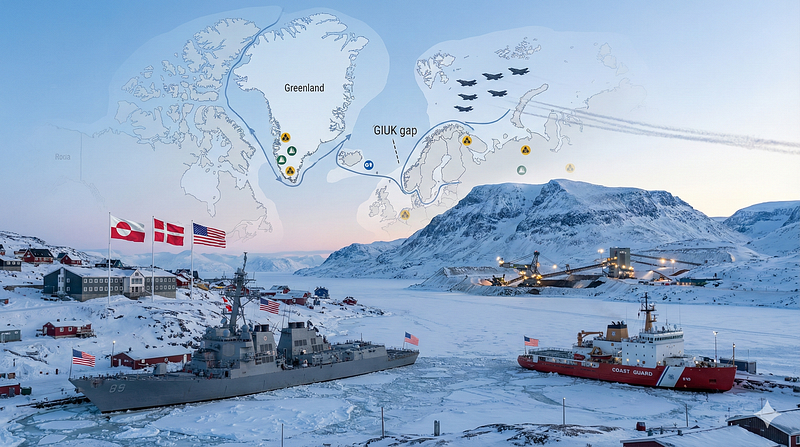
If you’ve been following the headlines this January, you know the Arctic is no longer just about polar bears and melting ice. The diplomatic temperature has dropped to sub-zero following the White House’s renewed pressure on Denmark regarding the status of Greenland.
What started as trade talks has rapidly escalated into what analysts are now calling the Greenland geopolitical crisis. With “Operation Arctic Endurance” currently mobilizing naval assets in the North Atlantic, the question on everyone’s mind is: Why?
Why is the United States willing to risk a diplomatic rift with a key NATO ally over an island with a population smaller than a football stadium?
The answer isn’t just “buying real estate.” It is about the future of global warfare, technology, and trade. Here are the 5 critical reasons why Washington is obsessed with Greenland in 2026.
1. The “Saudi Arabia of Rare Earths”
The primary driver of the Greenland geopolitical crisis is buried in the Kvanefjeld plateau. As the US scrambles to decouple its supply chains from China (which still controls the vast majority of rare earth processing), Greenland has emerged as the ultimate alternative.
The island holds one of the world’s largest undeveloped deposits of Rare Earth Elements (REEs) — specifically neodymium, praseodymium, and terbium. These are the non-negotiable ingredients for EV batteries, wind turbines, and, crucially, the guidance systems of F-35 fighter jets.
Washington sees continued Chinese investment in Greenlandic mining (via companies like Shenghe Resources) as a direct national security threat. The US logic is simple: If we don’t control these minerals, our geopolitical rivals will.
2. The “Unsinkable Aircraft Carrier” (Pituffik Space Base)
You might still know it as Thule Air Base, but its strategic value has only grown since it was renamed Pituffik Space Base. Located halfway between Moscow and New York, it is the US military’s northernmost installation.
In an era of hypersonic missiles, seconds matter. Pituffik hosts the AN/FPS-132 Upgraded Early Warning Radar, which serves as the “eyes” of the US missile defense system. If Russia were to launch a strike over the North Pole, Pituffik would be the first to see it. Washington’s fear is that an independent Greenland could neutralize this base or, worse, lease land to a rival power for a listening post.
3. Closing the GIUK Gap
The “GIUK Gap” (Greenland-Iceland-United Kingdom) is a naval choke point that Russian submarines must pass through to enter the Atlantic and threaten the US East Coast.
During the Cold War, this was the most surveilled patch of ocean on Earth. In 2026, with the Russian Northern Fleet revitalized and operating deeper in the Atlantic, the US Navy needs Greenland to “close the gate.” Controlling the waters around Greenland allows NATO to track Russian submarines the moment they leave the Arctic basin. Losing access to Greenland’s ports and airfields would effectively leave the back door to the Atlantic wide open.
4. The Northwest Passage: The New Panama Canal
Climate change has moved faster than diplomacy. As sea ice recedes, the Northwest Passage is becoming a viable commercial shipping route, cutting weeks off the transit time between Asia and Europe.
Whoever controls the coastline of this route controls the future of global trade. Washington views the passage as “internal waters” (via Canada/North America), while China and others view it as an “international strait.” By securing a dominant footprint in Greenland, the US ensures it can regulate — and if necessary, blockade — this emerging superhighway.
5. The “Arctic Monroe Doctrine”
Finally, there is the simple geopolitical imperative of denial. The US Administration is effectively applying a 21st-century version of the Monroe Doctrine to the Arctic: No rival powers in our hemisphere.
With China declaring itself a “Near-Arctic State” and investing heavily in icebreakers and mining infrastructure, the US is moving to pre-emptively block Beijing’s entry into the region. The logic driving the current crisis is that if Greenland becomes fully independent without a US security guarantee, it becomes vulnerable to Chinese debt-trap diplomacy. Washington is acting now to ensure Nuuk looks west to America, not east to Asia.
The Bottom Line
The “obsession” isn’t madness; it’s calculated strategy. In 2026, Greenland is no longer just an island; it is the central board for the next phase of Great Power Competition.