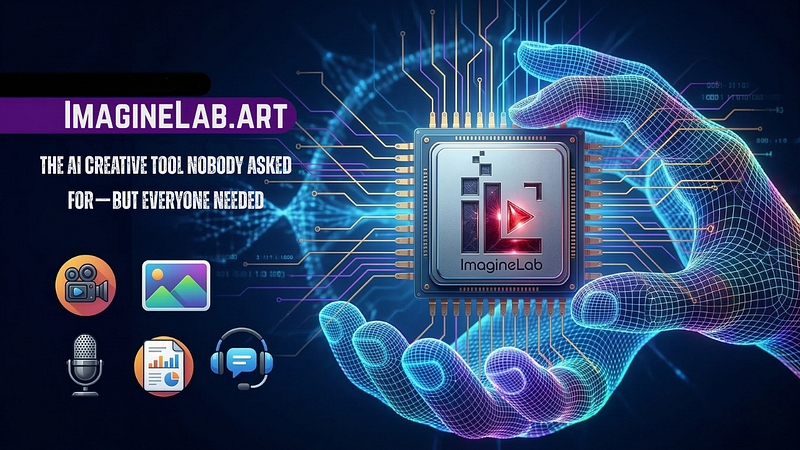
ImagineLab.art: The AI Creative Tool Nobody Asked For — But Everyone Needed
Here’s a thought experiment.
Here’s a thought experiment.
Open your browser tabs right now. How many of them are AI tools? One for image generation. Another for video. A separate tab for voiceovers. Maybe a design tool you’re using to stitch it all together. Each with its own login, its own billing cycle, its own learning curve.
Now imagine closing all of them — and replacing them with one.
That’s the bet Editorialge Media LLC made when they launched ImagineLab.art on March 7, 2026. And after spending time with the platform, it’s a bet worth paying attention to.
The Problem Was Always Fragmentation
The generative AI boom gave creators extraordinary tools. It just gave them separately.
Since 2022, the market has exploded with specialized platforms — each exceptional at one thing, each requiring its own subscription, its own prompt logic, its own mental overhead. The result? Creative professionals now manage four, five, sometimes six AI subscriptions just to produce a single piece of multimedia content.
It’s not a tools problem. It’s an architecture problem.
ImagineLab.art is an architectural answer. Rather than building another specialized tool, Editorialge’s founder and CEO Mr. Sukanta Kundu Parthib made a different call: consolidate the best-in-class engines for image, video, voice, and infographics under a single intelligent workspace — and unify the billing under a single credit system.
The result is something that genuinely doesn’t exist elsewhere in the market.
What ImagineLab Actually Does
ImagineLab.art is a browser-based AI creative studio. No installs. No plugins. Everything runs in one tab.
The platform covers four creative modalities that most content workflows require:
Video is powered by two distinct engines. Google’s Veo 3.1 handles cinematic output — photorealistic motion, true-to-life physics, full 4K resolution. This is the engine for brand films, product advertisements, and anything where production value is the point. Kling O1 takes the other lane: character motion, anime-style animation, dynamic action sequences. The practical rule is simple — Veo for realism, Kling for kinetic energy.
Image generation runs across two model families with genuinely different philosophies. The Flux 2 family (Flex, Pro, Max) is the artistic engine — highly responsive, stylistically versatile, excellent for designers who want creative latitude. The Imagen 4.0 family thinks more like a photographer: hyper-realistic lighting, photographic textures, and — crucially — accurate text rendering inside images. Need a product mockup with your brand name spelled perfectly on a neon sign? Imagen 4.0 is currently one of the only models that can do that reliably.
There’s also Nano Banana — the internal codename for Google’s Gemini Image model family, and arguably the most interesting addition. Nano Banana Pro uses a reasoning engine: it thinks before it draws, analyzing structural logic before generating output. For typography-heavy designs and spatial layouts where precision matters as much as aesthetics, this is meaningfully different from anything else on the market.
Audio uses Gemini 2.5 Flash to convert scripts into natural speech across 30+ professional AI voices. The Flash architecture is built for speed — a 5-minute narration generates in seconds.
Infographics is where the platform does something genuinely novel. Instead of generating an image of a chart (which standard models hallucinate badly), ImagineLab’s Logic Engine — powered by Gemini 3.0 Pro — writes structural SVG code from raw data. Feed it a spreadsheet. Get back a mathematically accurate, publication-ready chart. It’s the difference between a model that paints data and one that renders it.
One Credit to Rule Them All
The platform runs on EDT — Editorialge Digital Tokens — a proprietary credit system that sits above all the underlying AI engines.
This is smarter than it sounds.
Instead of paying per model at opaque API rates that change without notice, users hold one EDT balance and allocate it freely across any tool on the platform. The practical wisdom built into the system: use Fast model tiers for drafting and iteration; reserve Pro and Ultra tiers for final, publication-ready renders. Prototype cheaply. Perfect expensively — only when it matters.
From a user psychology standpoint, this matters. People are more willing to experiment with a new tool when experimenting doesn’t require a separate billing decision. EDT removes that friction.
It’s also a strategic signal. A credit abstraction layer built at this level of sophistication is infrastructure for a marketplace, not just a product. The architecture is clearly designed to onboard additional services and third-party tools over time.
The Market Nobody Else Is Serving
One of ImagineLab.art’s most significant decisions at launch is one most Western AI platforms haven’t made: building for South Asia from day one.
Deputy Technical Lead Mr. F. Al Mamun implemented native support for Bangladesh’s bKash mobile financial platform and India’s UPI (Unified Payments Interface) alongside international options Stripe and PayPal.
This is not a cosmetic localization. It’s a structural market decision.
Premium AI tools — typically priced in USD, accessible only via credit card or Stripe — have been functionally out of reach for the vast majority of South Asian creators. bKash alone has over 65 million registered users in Bangladesh. UPI processes over 10 billion transactions monthly in India. South Asia has one of the fastest-growing digital creator economies in the world, and until now, the generative AI industry had largely ignored it.
ImagineLab.art is positioning itself as the first premium unified AI creative platform to genuinely serve this market. That’s a first-mover position in a creator economy of enormous scale.
Who Built It
The platform was architected under the strategic direction of Mr. Sukanta Kundu Parthib, whose founding insight was precise: the AI market was producing extraordinary tools at extraordinary pace, but the structure of that market — fragmented, subscription-heavy, API-obscured — was creating barriers for the people who most needed those tools.
Independent creators. Small agencies. Entrepreneurs who need visual storytelling but can’t justify managing a multi-tool AI stack.
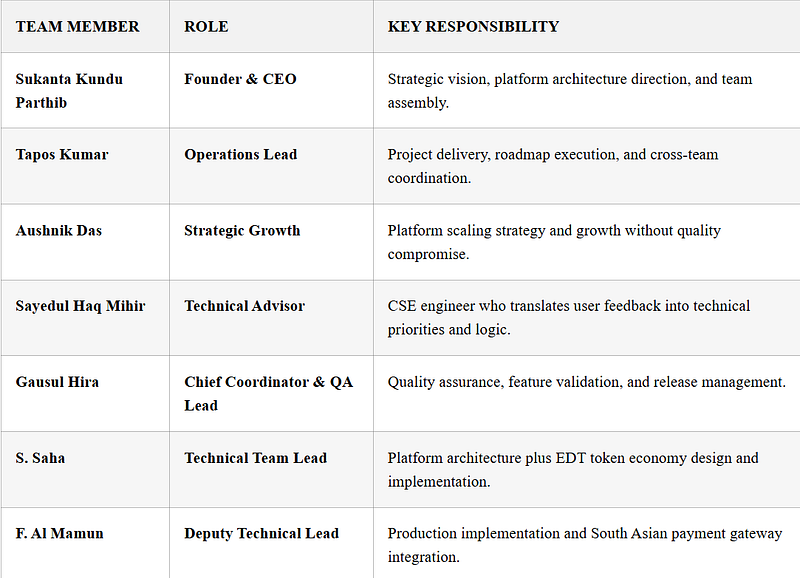
The technical build was executed by a lean distributed team from BTS, Editorialge’s strategic technical partner, led by S. Saha and F. Al Mamun. The full team spans operations, growth strategy, technical advising, QA, and coordination — a small, focused configuration that reflects both Editorialge’s operational model and a deliberate philosophy: small teams with clear mandates build the most impactful products.
The NestJS microservices architecture they chose is also a forward-looking decision. In an AI landscape where leading models are replaced on 12–18 month cycles, a platform where individual model services can be swapped or upgraded without destabilizing the whole is a meaningful structural advantage. When Veo 3.1 becomes Veo 5, ImagineLab upgrades a service. The user experience stays the same.
Where It Sits in the Market
The honest competitive picture:
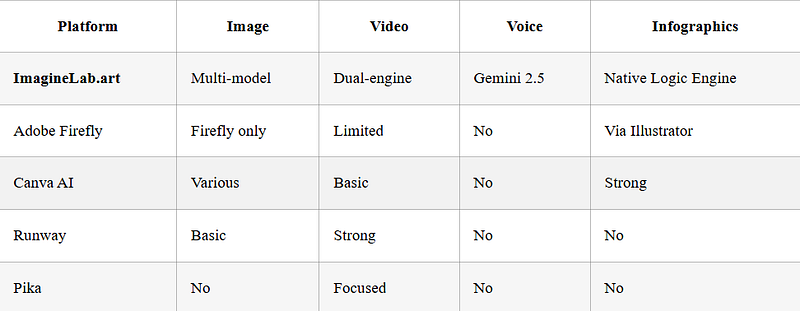
No competitor treats all four modalities — image, video, voice, and infographics — as first-class citizens within a single interconnected workflow. The established platforms are deep in one or two lanes. ImagineLab is intentionally broad and, from what’s visible at launch, genuinely integrated.
The Honest Assessment
ImagineLab.art launches with the right architecture, a smart credit economy, a compelling market thesis, and a model lineup — Veo 3.1, Imagen 4.0 Ultra, Flux 2, Gemini Voice, Nano Banana Pro — that represents some of the most capable generative AI currently available to any creative platform.
Whether it can deliver on that promise consistently, at scale, across all those engines simultaneously — that’s the question the next few months will answer.
What’s clear is that the architecture is built for longevity, not for a moment. The market insight is real. The South Asian growth play is genuinely underserved. And the unified workflow proposition — one tab, one balance, four creative modalities — addresses a friction that creators have lived with since the AI boom began.
The generative AI industry needed consolidation. ImagineLab.art is making a serious, technically grounded attempt to provide it.
That’s worth watching.
ImagineLab.art is available now. Explore the platform at imaginelab.art.