I Tried 6 Side Hustles in 6 Months; Only One Actually Made Real Money
Let me be upfront with you before you read a single word further. I am not a guru. I do not have a course to sell you. I did not make six…
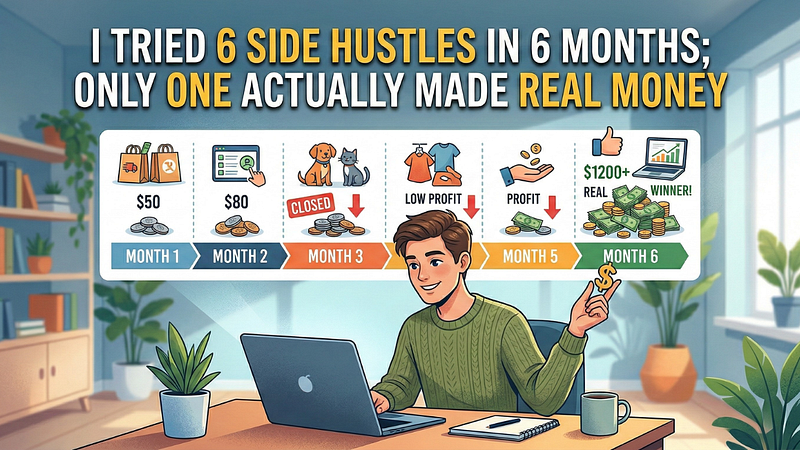
Let me be upfront with you before you read a single word further. I am not a guru. I do not have a course to sell you. I did not make six figures in my pajamas. What I did was spend six months trying every side hustle that showed up in my feed, my search results, and my inbox — the ones with the glossy YouTube thumbnails, the Reddit threads full of success stories, and the Pinterest pins promising $500 a week from home.
And I am here to tell you that most of it is noise. Beautiful, well-marketed noise. Out of six different income streams I genuinely committed to — with real time, real effort, and in some cases real money — only one actually made enough to be worth calling income. This article is the full, unfiltered story of all six.
The side hustle economy is real — but so is the failure rate. According to a 2025 Bankrate survey, the median side hustle income in the U.S. is just $200 per month. The average sounds better at $885, but that number is pulled up by a small group of high earners. Most people are making far less than they expected.
I want to be that honest number for you. Not the average. The real median. Because I spent a long time chasing the average before I figured out what actually works. So let us get into it — month by month, dollar by dollar, failure by failure.
Why I Started This Experiment
It was October. I had just gotten hit with an unexpected car repair bill that wiped out most of my savings buffer, and my salary — steady as it was — was leaving me with almost nothing after rent, utilities, and groceries. I was not in a crisis. But I was in that uncomfortable place where one more unexpected expense would tip everything over.
I had been hearing about side hustles for years. My social media feed was full of people documenting their journeys — the Etsy sellers, the dropshippers, the freelancers, the digital product creators. It all looked so achievable. Just a few hours a week, they said. Fully passive, they promised. I decided to find out which ones were real.
I gave myself six months and a simple rule: commit to each side hustle fully for one month before moving on. No half-efforts. No quitting after three days because it was slow. One month, full commitment, honest results.
According to a 2025 LendingTree survey, nearly 38% of Americans have a side hustle, and 61% of those say their life would be unaffordable without that extra income. I wanted to understand what those people were actually doing — and whether any of it was real.
The 6-Month Summary: Before We Dive In
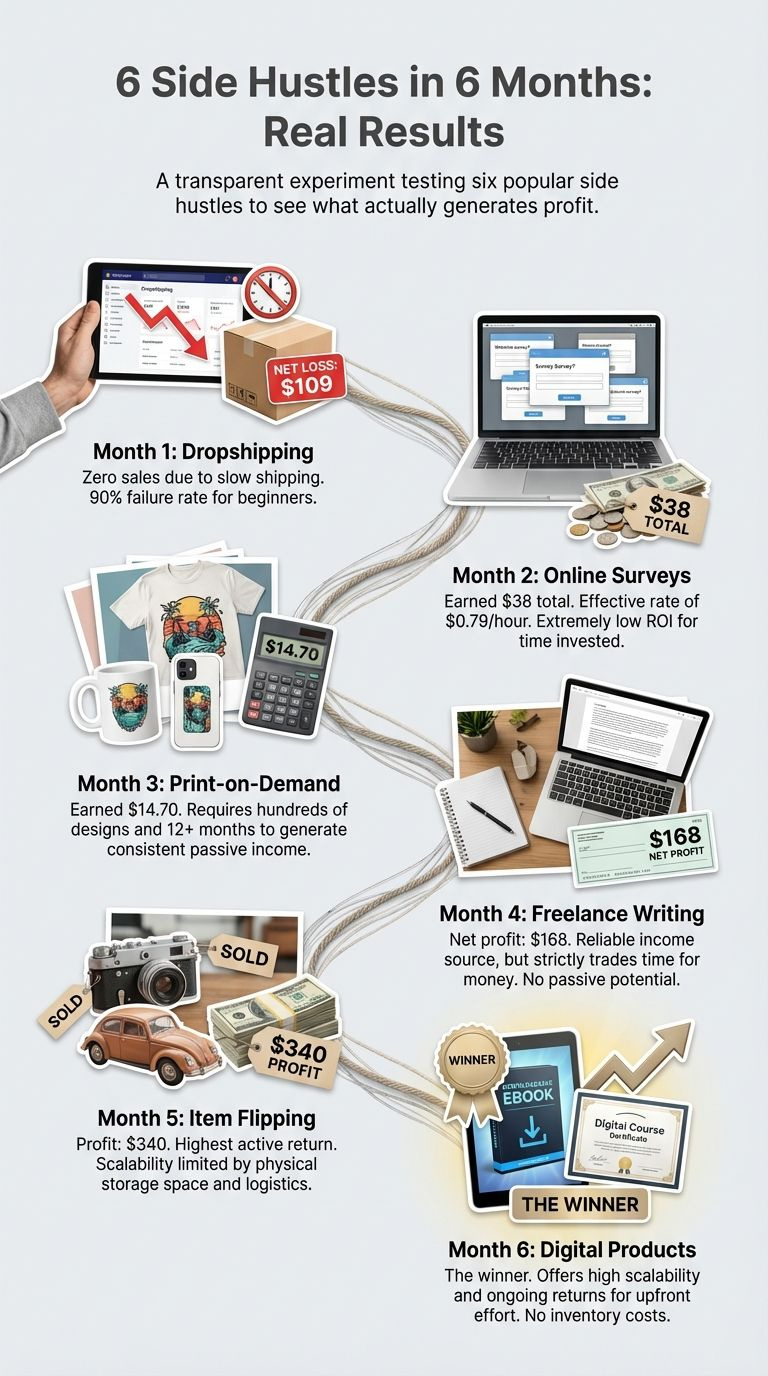
Here is a quick overview of all six hustles so you can see the full picture before I walk you through each one in detail.
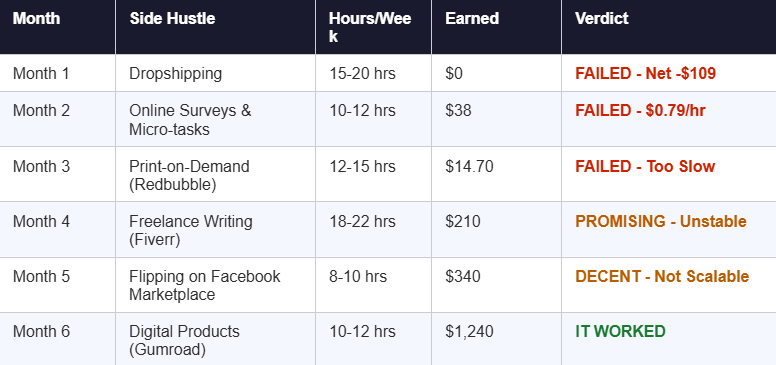
Total earned across six months: $1,842.70 | Total hours invested: ~300+ hours | Months that felt like a waste: 4 out of 6
Month 1: Dropshipping — The One That Sounds Best and Delivers Nothing
Every YouTube algorithm rabbit hole about side hustles eventually leads you to dropshipping. The pitch is intoxicating: find products, list them in your online store, and when someone orders, a supplier ships directly to them. No inventory, no warehouse, just profit margin. I watched probably thirty hours of tutorials before I even started.
I set up a Shopify store ($29/month), connected it to an AliExpress product catalog through DSers, and spent two weeks building a niche store around minimalist home office accessories. I even ran a small Facebook ad campaign ($80 in ad spend) to get my first traffic.
What Actually Happened
I got clicks. I got add-to-carts. I got zero purchases. After a full month, my store had attracted 347 sessions, 41 add-to-cart actions, and exactly 0 completed checkouts. When I dug into why, the answers were depressing but obvious in hindsight: shipping times from AliExpress suppliers were 3 to 5 weeks, which every potential buyer could see. My prices were not competitive with Amazon. And I had no brand trust because I was a week-old website nobody had ever heard of.
Dropshipping has an extremely low success rate for new entrants. Most estimates put the failure rate for new dropshipping stores within the first year above 90%. The ones that succeed have usually invested significantly in branding, advertising expertise, and supplier relationships.
Month 1 earnings: $0 | Costs: $109 | Net: -$109
The hardest part was not the failure itself. It was how long I had been told it was easy.
Month 2: Online Surveys and Micro-Tasks — The Slow Drain
The Appeal
After the dropshipping experiment left me out of pocket, I wanted something with zero financial risk. Online surveys and micro-task platforms like Swagbucks, InboxDollars, Amazon Mechanical Turk, and Prolific seemed perfect. No investment needed. Just time. I signed up for six platforms and committed to spending 10 to 12 hours per week doing tasks.
The Reality
By the end of week one, I had earned $4.20. Not per hour. Total. I kept meticulous notes. On my best day, I made $3.80 in about three hours of work on Prolific, which actually has the most legitimate and reasonably-paid studies among the platforms I tried. Everything else — Swagbucks, InboxDollars — was an exercise in collecting tiny fractions of cents while being served endless pop-up ads.
After a full month of 10 to 12 hour weeks, my total earnings were $38. That works out to roughly $0.79 per hour. For context, the U.S. federal minimum wage is $7.25 per hour. I was earning about 11% of that.
Survey and micro-task platforms are real in the sense that they do pay out. But according to multiple independent analyses, most survey platform users earn between $1 and $5 per hour of active time — making it one of the lowest-ROI options available for anyone trying to build meaningful income.
Month 2 earnings: $38 | Hours worked: ~46 | Effective hourly rate: $0.79
I do not regret trying it. But if your time has any value at all, this is not a side hustle. It is a very slow, very boring way to donate your evenings.
Month 3: Print-on-Demand — The Patience Game I Was Not Ready For
The Setup
Print-on-demand was the next logical step. The concept is similar to dropshipping but feels more creative: you design graphics, upload them to platforms like Redbubble, Merch by Amazon, or TeePublic, and earn a royalty whenever someone buys a product with your design. No inventory, no shipping, no upfront cost.
I am comfortable with Canva and basic design tools, so I committed to creating 40 designs over the course of the month — quotes, minimalist illustrations, niche-themed graphics for hobbies like hiking, chess, and houseplants. I did my research on niches with lower competition. I read all the guides. I uploaded consistently.
The Numbers
In month three, I sold three items. One sticker. One tote bag. One mug. Total royalties: $14.70. When I dug into why, the answer was simple and maddening at the same time: print-on-demand is a long-tail game. Successful POD sellers often have hundreds or even thousands of designs live before they see consistent income. Three months in, many of them are still making under $50 a month.
Print-on-demand can become genuinely passive income — but only after a significant volume of designs has been published and indexed. Most successful POD sellers report that meaningful income began only after publishing 200 to 500+ designs over 12 to 18 months.
Month 3 earnings: $14.70 | Designs uploaded: 40 | Items sold: 3
I still have those designs live. As of the time of writing, the cumulative total across all months since then is $67.40. It is technically income. But it is not something I can plan around.
Month 4: Freelance Writing on Fiverr — The One That Showed Promise
Why This Felt Different
By month four I was starting to understand something important: the hustles that had failed were the ones where I was trying to build passive income without building anything of value first. So I went back to basics. I can write. I write well. I set up a Fiverr profile offering blog post writing, website copy, and social media captions — the exact things I do at work, packaged as a service.
I spent a weekend building out my profile, writing detailed gig descriptions, and creating a portfolio of sample pieces. I priced myself at the lower end intentionally to get reviews: $25 for a 500-word blog post, $45 for 1,000 words.
What Month Four Looked Like
It took eleven days to get my first order. A small business owner wanted two 600-word product description pages. I delivered them in 48 hours. She left a five-star review. Within a week I had three more orders from people who found my profile through that review.
By the end of month four I had completed nine orders and earned $210 before Fiverr’s 20% commission cut. Net to me: $168. It was not life-changing money. But it was real, earned money that came from a skill I already had.
Freelance writing is one of the most accessible entry points into the gig economy. According to a 2024 DollarSprout survey, online freelance work was among the top two most popular side hustles in America. The challenge is consistency — getting a steady flow of clients takes time and reputation-building.
Month 4 earnings: $210 gross / $168 net | Orders completed: 9 | Avg order value: $23.30
The issue with freelancing is that your income is directly tied to your hours. The moment you stop working, you stop earning. For a true side hustle, I needed something that did not require me to trade time for every single dollar.
Month 5: Flipping Items on Facebook Marketplace — Old School, Surprisingly Real
The Premise
Month five was an experiment in the most old-school hustle imaginable. I had read about people making serious money buying items cheaply at garage sales, thrift stores, and on Facebook Marketplace itself, then reselling them at a markup. No design skills needed. No platform learning curve. Just pattern recognition and patience.
I set myself a starting budget of $100 and a rule: only buy things I could sell for at least double the purchase price within two weeks.
What I Bought and What I Sold
My first flip was a standing desk listed for $40 that had a small scuff on one leg. I collected it, cleaned it up, and relisted it for $95. It sold in four days. Over the course of the month I flipped a coffee table, a vintage film camera, two office chairs, and a set of unused kitchen appliances. The most profitable single flip was a like-new bread maker I bought for $12 at a thrift store and sold for $55.
Reselling or flipping items was the single most popular side hustle category in a 2024 DollarSprout survey, cited by 39.4% of respondents — ahead of even freelance work. The barrier to entry is low, but income is capped by physical logistics and local market demand.
Month 5 earnings: $340 | Items flipped: 8 | Starting capital: $100 | Ending capital: $440
Flipping was fun and surprisingly profitable. But I live in an apartment. Storage space is limited. And spending weekends driving around to collect and deliver furniture is not scalable. Month five proved that physical flipping works — it just has a ceiling, and that ceiling is your space and your time.
Month 6: Digital Products on Gumroad — The One That Actually Changed Things
What Made Me Try This
By month six I had tried everything that showed up in the mainstream side hustle conversation. And I had started to notice a pattern in everything that had not fully worked: they were all either time-for-money trades, or they required so much upfront effort before any income appeared that the average person would have quit long before seeing results. What I wanted was something that rewarded upfront effort with ongoing returns. Digital products felt like the answer.
The idea was simple: create something useful that people need, price it accessibly, and sell it through Gumroad. No platform fees on the free plan. No shipping. No inventory. Just a file and a price.
What I Created
I spent the first ten days of month six creating four digital products. All of them were things I had already made for my own use or for my work — I just cleaned them up, added better instructions, and packaged them professionally using Canva. I did not buy any tools. I did not hire anyone. My total cost of production was zero.
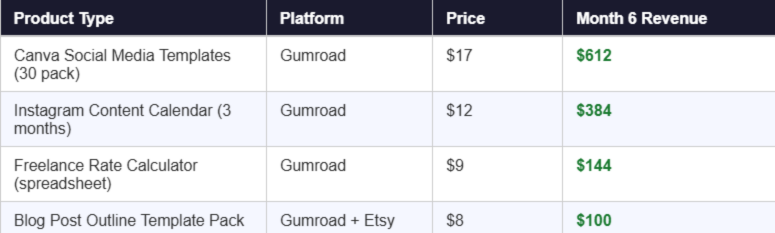
I listed the products on Gumroad and shared them in three places: a relevant Facebook group for freelancers, a Reddit thread where someone had asked about social media planning tools, and my own personal Instagram story. No paid advertising. No influencer partnerships. Just genuinely useful products placed in front of people who needed them.
What Month Six Actually Looked Like
The first sale came 36 hours after I listed the Canva template pack. It was $17. I remember exactly where I was when the Gumroad notification came through — sitting at my kitchen table eating breakfast. I stared at my phone for a full minute. It sounds dramatic, but it was the first time in this entire experiment that I had made money while doing something completely unrelated to making money.
By the end of month six I had made $1,240 from 91 transactions across four products. My best week was week three, when the Canva templates started getting shared organically in a Facebook group I was not even a member of. Traffic I had not created. Sales I had not worked for directly. That is what passive income actually looks like when it is working.
The digital products market has seen explosive growth, with platforms like Gumroad, Etsy, and Payhip processing millions in creator transactions annually. The advantage of digital products over physical goods is clear: there is no cost of goods, no shipping, and no inventory limit. Every additional sale is near-pure margin.
Month 6 earnings: $1,240 | Products: 4 | Transactions: 91 | Total hours: ~38
The math is striking. 38 hours of total work across creation and marketing. $1,240 earned. That is an effective rate of $32.63 per hour — and those products are still selling every single week.
What Six Months of Failures Actually Taught Me
Lesson 1: Passive Income Has to Be Built — It Cannot Be Shortcut
Every side hustle that promised passive income from day one delivered nothing. Dropshipping, surveys, print-on-demand — all of them framed themselves as low-effort paths to automatic money. None of them were. The only thing that created real passive income was something I built with genuine effort in the first place. The passive part came after the work. It was never instead of it.
Lesson 2: Your Best Hustle Uses Skills You Already Have
Freelance writing worked because I already knew how to write. Digital products worked because I already used Canva and created templates for myself. The two hustles that generated real money were not things I had to learn from scratch — they were things I had to package properly. There is a big difference, and it is one that most side hustle content completely glosses over.
Lesson 3: The Median Is More Honest Than the Average
The median side hustle income in the U.S. is $200 per month according to Bankrate’s 2025 data. That number is more honest than the $885 average because the average is skewed by a small group of very successful earners. Most people who try a side hustle make very little. Knowing that going in would have saved me a lot of inflated expectations in months one through three.
Lesson 4: Scalability Matters More Than Income in Month One
Flipping furniture made me $340 in month five. Digital products made me $1,240 in month six. But in month seven — the month after this experiment officially ended — flipping brought in another $280 while digital products brought in $1,890 without any new products created. The scalability gap between the two is enormous.
Lesson 5: Distribution Is the Real Product
The biggest unlock in month six was not creating better products. It was realizing that getting products in front of the right audience — even organically, even in small communities — was more important than anything else. The Canva templates I sold were not the best Canva templates on the internet. But they were in the right Facebook group at the right time. Distribution beats product quality in most markets, at least at the start.
Which Side Hustle Is Right for You?
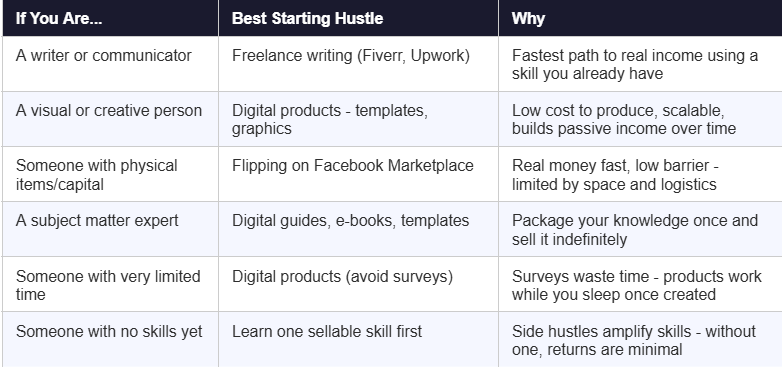
Based on six months of personal experimentation, here is my honest recommendation guide — not what sounds best in a YouTube thumbnail, but what actually matches different situations.
Final Thoughts: The Hustle Nobody Tells You About
Six months. Six experiments. $1,842.70 total earned. Roughly 300+ hours invested across all of them. When I laid it all out at the end of month six, the most striking thing was not the number in the digital products column — it was how much of my time had been spent on things that returned almost nothing.
If I had skipped straight to month six, I would have saved approximately 240 hours and $109 in costs. But I also would not have understood why it worked. The failures are not wasted. They are the curriculum. They teach you what passive income is not before they let you find what it actually is.
The real side hustle truth that nobody wants to put in a thumbnail is this: most side hustles fail because people choose them based on potential income rather than personal fit. Dropshipping can make people rich — just not most people, and not quickly. Surveys are real income — just not enough to matter. Print-on-demand works — just not in month one, or month three, or sometimes even month six.
What worked for me was the intersection of something I could make quickly, something people genuinely needed, and a price point low enough that buying was an easy decision. Digital templates hit all three. Your intersection might be different. Your skills are not mine. Your audience is not mine. But the principle holds.
According to a 2025 Bankrate survey, 82% of side hustlers say having a side hustle prevented them from living paycheck to paycheck. That statistic is real. But it belongs to the people who found the right fit — not the people who simply tried the trending option.
Find your fit. Build it properly. Expect the first few months to teach you more than they pay you. And when the notification comes through while you are eating breakfast and you have not done anything that morning except make coffee — that feeling is worth every failed month that came before it.
Because the best side hustle is not the most popular one. It is the one that is built on something real that you already have.